
What is the SPEAR System®?
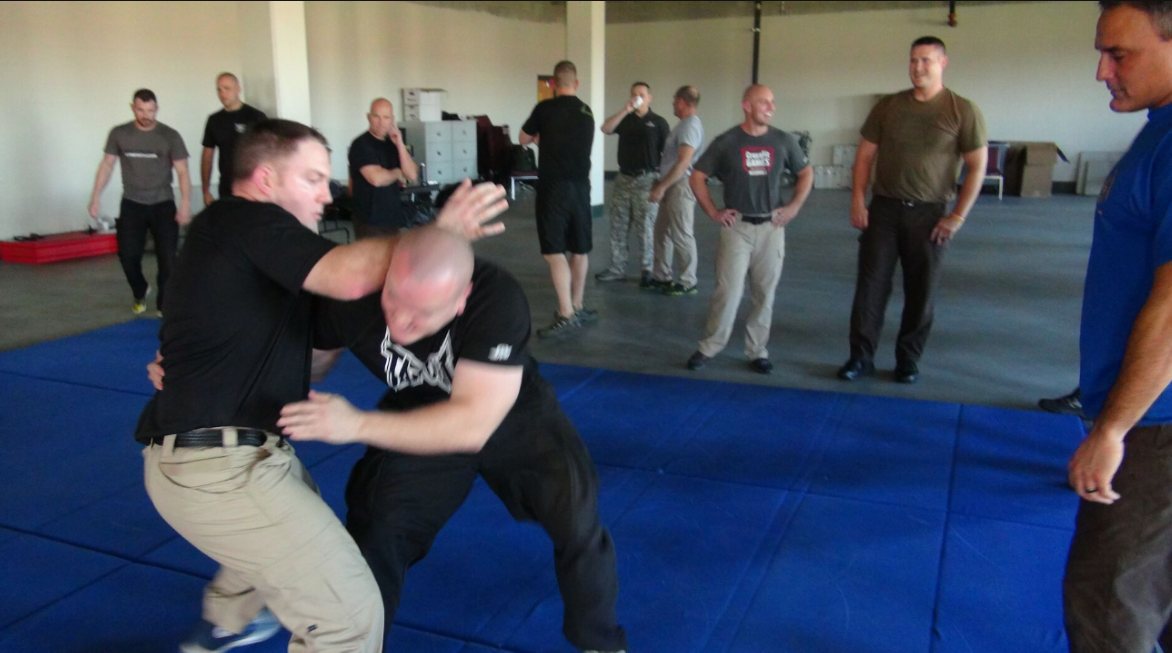
The SPEAR System® is not a stylized martial art. It is a study of human movement as it relates to violence, fear, and aggression.
- The SPEAR System® is not a stylized martial art — it is a study of human movement under threat.
- It converts your body's natural startle-flinch into a trainable, protective response.
- It is grounded in psychology, kinesiology, and neurobiology — not memorized technique.
- Because everyone flinches, it works regardless of size, age, or training background.
A science-based study of how humans move under threat
The SPEAR System® is not a stylized martial art. It is a study of human movement as it relates to violence, fear, and aggression. We exclusively use the sciences of psychology, kinesiology, and neurobiology — which makes the system the easiest to learn and the most reliable during sudden danger.
When something startles you, your body flinches — arms rise, chin tucks, hips move away. That reflex is faster than any trained technique because it doesn't wait for a decision. The SPEAR System® takes that universal reaction and converts it into a protective, offensive-capable movement.
Created by Coach Tony Blauer over 45+ years of research into fear, confrontation management, and human performance under stress, the methodology has been taught in over 30 countries to everyone from law enforcement and military to moms and dads, from pilots to school teachers, firefighters to hospital workers.
Just as important: the physical tool is the last layer. The system starts with awareness, threat recognition, and de-escalation — and pairs it with the KNOW FEAR® fear-management methodology so you can function when adrenaline hits.
It Started With a Loss. 1980.
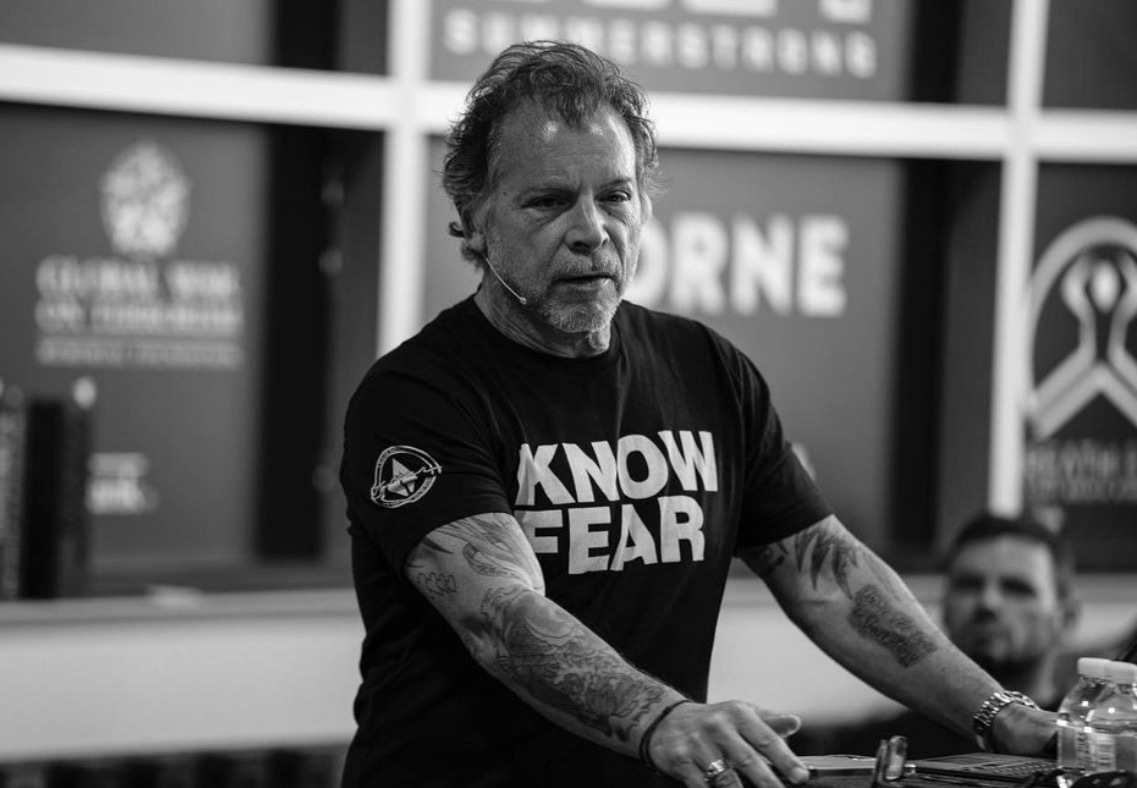
One of my students lost a fight, and it hit me harder than he got hit. When he told me how it went down, how he was sucker punched, I had a profound realization: self-defense is taught incorrectly.
I was like so many martial art instructors who believed they were teaching self-defense. What I realized was that I had been teaching him combat sports and martial tactics that I assumed also applied to self-defense.
We were missing context. There was no scenario. And because there was no scenario, we didn't understand how a real scenario impacts physiology, physics, and psychology. We agree to spar. We agree to enter a contest. But we don't agree to be the target of sudden violence.
The truth is: I had failed to prepare my student properly. I was teaching him what my instructors taught me — how to fight. True self-defense has a lot more to do with learning how to choose strategies so you don't need to fight.
The first thing I did was take responsibility. I apologized to Mitch. Then, in the same session, we reverse-engineered his confrontation: the pre-fight moments, the language, the grab, the sucker punch. We didn't get technical. We got tactical.
That was the day my approach to scenario-based self-defense was born. I had one goal that consumed me that day, and it's the one I have four decades later: How can I make good humans safer?
In 1987, I Designed an Experiment That Guaranteed My Failure.
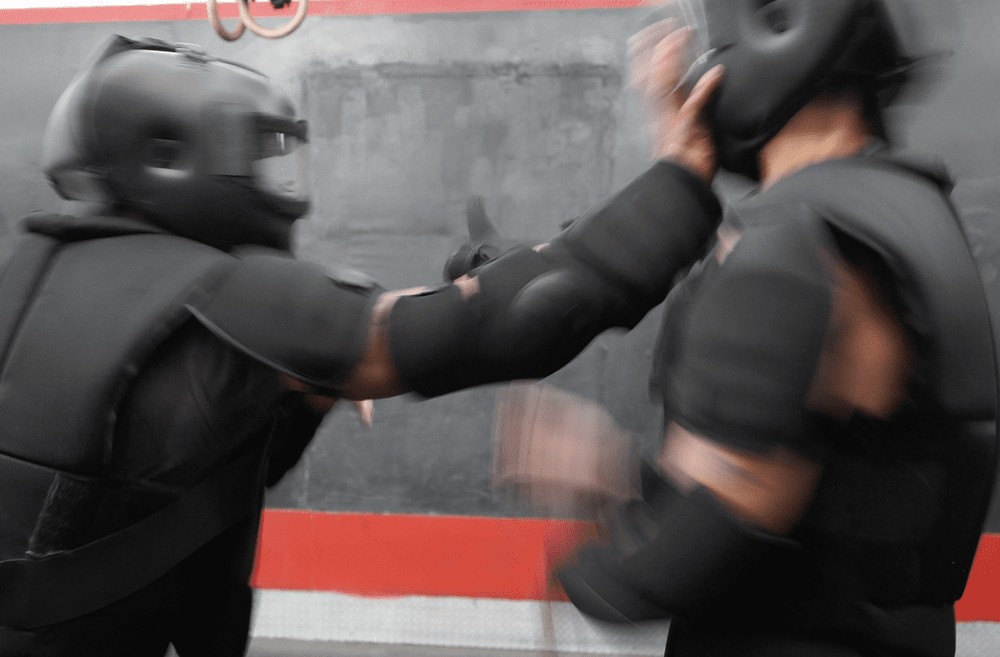
My student Warren, a very skilled boxer, wore 16oz gloves. I wore only a mouthguard. The rule was simple: he could hit me whenever he wanted. My only job was to stand there and talk to him. I couldn't hit back.
We were not sparring. We were replicating scenarios. He would ask me for money like a loan shark, or ask for the time and then strong-arm mug me. When you are talking, you are distracted. Even in a drill, the person answering a question is completely compromised.
For an hour, I got my face punched in.
I found out that proximity was everything. If you were talking, you could not access your fighting skills the way you did in the ring. A horrifying thought hit me: How are people supposed to do this in a real fight?
I realized something deeply irresponsible was happening in the martial arts world. We, as instructors, were telling people, "Just do this," when "this" didn't even work under pressure.
Then something magical happened. Because of fear and how ineffective my tactical toolbox was, my body's survival system bypassed my thinking brain. A primal instinct took over. I flinched.
There is nothing faster than the flinch. In that moment, I was immediately safer. I was getting hit less. The startle-flinch — a primal gross motor movement, not a trained response — was intercepting every punch Warren threw. The flinch was faster. It will always be faster.
It was in that moment the biological airbag concept was born. And it led to the thesis of the SPEAR System®: What does your body want to do prior to any training? Does that have a protective or tactical application? If so, why aren't we using it?
Quite literally, the central nervous system of our self-defense program is based on the central nervous system. That was the revelation from 1987.
— Coach Tony Blauer
The startle-flinch response is a spinal reflex that can be anatomically defined via alpha and gamma motor neurons and sensory system neurons within the different systems of the body, i.e. auditory, touch and vision. (pages 36–42)
“Extensor strength is engaged to disengage from noxious stimuli via the cross extensor spinal level reflex and flexor reflex which is also at the spinal level. These are engaged at different rates depending on the mode of stimuli but they are uniform across the human species regardless of age and training.” (page 42)
The Science Underneath It
At its core, the SPEAR System® is built around the central nervous system. We reverse-engineered it by dissecting real violence and interviewing real victims and real victors.
Sudden violence triggers your survival system's crossed extensor reflex. It's non-conscious, which means it bypasses your thinking brain.
That's fantastic news, and it's confusing to people who want to believe in muscle memory. If muscle memory were a thing, we would see a lot more John Wick, Bruce Lee, Chuck Norris and Jackie Chan footage coming out of real violent encounters. The truth is we don't see any.
In that moment it's near impossible to access complex motor skills, which is why people flinch. That isn't my opinion. It's neuroscience.
You're going to flinch whether you like it or not. It's already hardwired in you. What I'm going to teach you is how to convert it — how to turn that flinch into what we lovingly refer to as a biological airbag.
The mind navigates the body.
Why It Works When Everything Else Freezes
Built on the flinch
The SPEAR converts your hardwired startle-flinch into a protective, tactical movement instead of fighting against it.
Behaviorally based
It works with human physiology under adrenal stress — not against it — so the skill survives real fear.
Ambush-ready
Real attacks come without warning. The system is designed for zero-notice, close-quarter encounters.
Detect, defuse, defend
Awareness and de-escalation come first. Physical tools are the last layer, not the first.
Pressure tested
Trained in HIGH GEAR® at full speed and full contact so you know what actually holds up.
Universally scalable
The same principles serve a police officer, a nurse, a teenager, and a CEO.
The Record
Since 1977, we've taught over half a million people. Thousands of defensive tactics and combatives instructors, and thousands of martial artists, have been certified to teach our program.
We are the only system in the world vetted on three different continents by independent physicians who have no professional relationship with us.
The SPEAR System® covers pre-fight, in-fight, and post-fight. It's court-defensible and already embedded in police policy in agencies around the world.
Here's one example. Dorset Police adopted our system, and across an independent five-year study they recorded a 41% reduction in head trauma. (The official report is available to government agencies only.)
The people who run toward the danger trust this program.
“When the history of this Warrior Renaissance is written, Tony Blauer will be remembered as one of the great pioneers who propelled us forward to the next evolutionary step in warriorhood.”
Lt. Col. Dave Grossman, U.S. Army (Ret.)Author of On Killing and On Combat
SPEAR System® FAQ
What does SPEAR stand for?
Spontaneous Protection Enabling Accelerated Response. More importantly, it is a behaviorally-based study of human movement under threat — not a stylized martial art.
How is it different from martial arts?
Martial arts often teach stylized techniques and memorized moves. The SPEAR System® begins with the human sciences of psychology, kinesiology, and neurobiology, and builds on the body's natural startle-flinch — a reflex that already exists before training.
Do I need to be fit or experienced?
No. The system is built on a reflex every human already has, so a complete beginner can learn it — and a black belt or a tactical professional will find it fills the gap their training leaves under a true surprise.
How long does it take to learn?
The core concepts can be learned in a single seminar or in the Be Your Own Bodyguard® digital program. Teaching it is a separate path: SPEAR System® Level 1 certification, then ongoing scenario work.
Where To Start
We have a program for you and we'll meet you where you are, whether that's a complete beginner or a black belt, a social worker or a Tier One operator.
SPEAR TIPS — Coach Blauer's free newsletter, every Saturday. Join free →